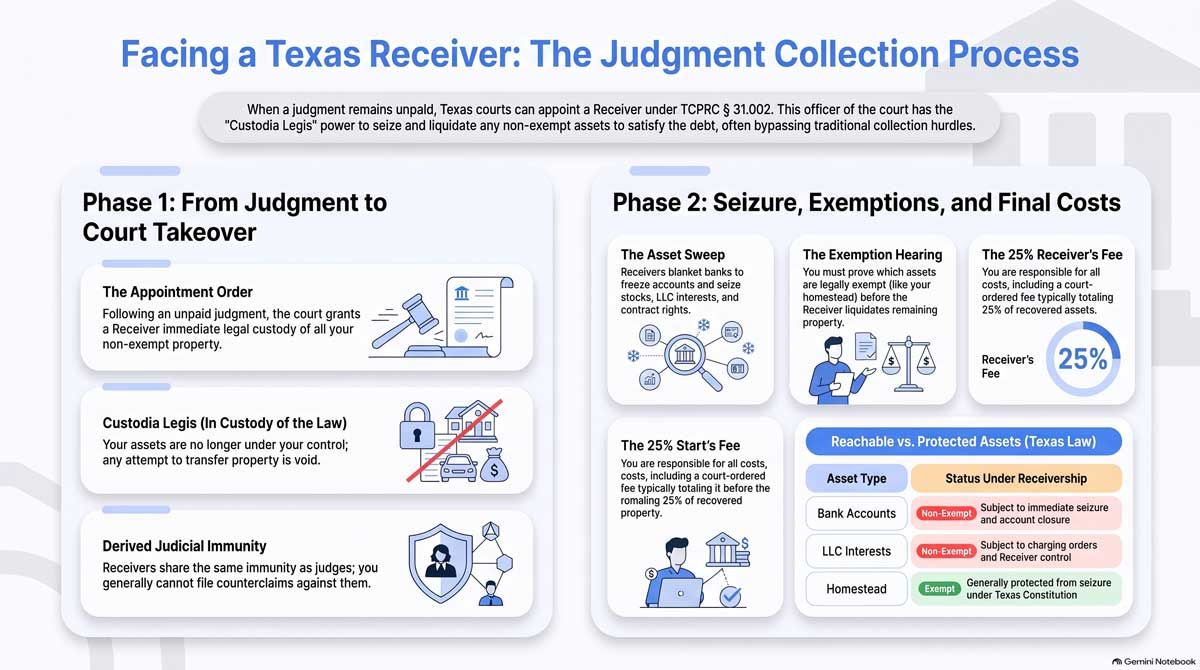
When a judgment remains unpaid, Texas courts can appoint a Receiver under TCPRC § 31.002. This officer of the court has the "Custodia Legis" power to seize and liquidate any non-exempt assets to satisfy the debt, often bypassing traditional collection hurdles.
Phase 1: From Judgment to Court Takeover
The Appointment Order
Following an unpaid judgment, the court grants a Receiver immediate legal custody of all your non-exempt property.
Custodia Legis (In Custody of the Law)
Your assets are no longer under your control; any attempt to transfer property is void.
Derived Judicial Immunity
Receivers share the same immunity as judges; you generally cannot file counterclaims against them.
Phase 2: Seizure, Exemptions, and Final Costs
The Asset Sweep
Receivers blanket banks to freeze accounts and seize stocks, LLC interests, and contract rights.
The Exemption Hearing
You must prove which assets are legally exempt (like your homestead) before the Receiver liquidates remaining property.
The 25% Receiver's Fee
You are responsible for all costs, including a court-ordered fee typically totaling 25% of recovered assets.
Reachable vs. Protected Assets (Texas Law)
| Asset Type | Classification | Status Under Receivership |
|---|---|---|
| Bank Accounts | Non-Exempt | Subject to immediate seizure and account closure |
| LLC Interests | Non-Exempt | Subject to charging orders and Receiver control |
| Homestead | Exempt | Generally protected from seizure under Texas Constitution |